Ok, so I did cringe slightly when writing that title, but you know what? It’s true! Stay with me here and lets unpick it further.
I don’t know about you but I like to feel good, I mean if we were all really honest, who doesn’t like to feel good within, and about, themselves? While as a coach I understand completely that feeling good has to come from something within ourselves, I think it is also important to acknowledge that self-care can be a factor within this.
Writing the above, I feel like I should instantly follow this discussion up with a clarification that it’s not about being vain, shallow or self-involved. And I think there in lies the problem, we are conditioned to think paying attention to ourselves and how this impacts on how we feel is somehow wrong. There are ways that self-care is acceptable and other ways in which it is seen in a more negative light.
I want to be really clear appearances are not everything, and self-care is about taking a holistic approach and thinking about a whole host of things; such as what we eat and drink, how much sleep we get, lifestyle and work-life balance. However, as part of my own self-care I do like to take care of my skin.
When your skin glows with health it can be incredibly empowering. Healthy glowy skin can lead to improved confidence and self-esteem and it can help you reframe your mindset; when you feel good about yourself you naturally feel better about the world around you. There is, after all, a reason why phrases like “feeling comfortable in your own skin” emerge.
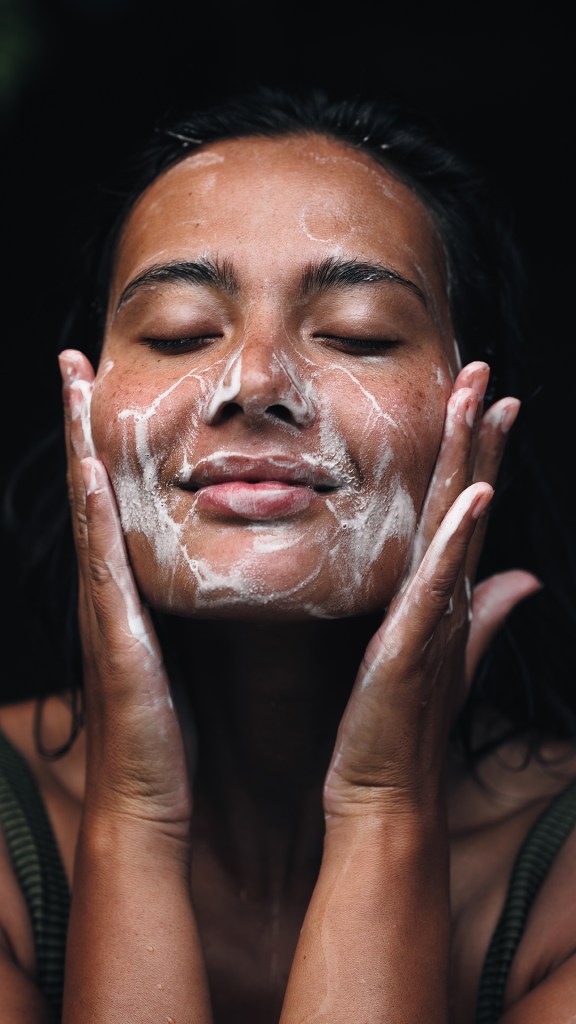
I feel like taking care of my skin is something I do just for me, just something ‘nice’ for myself, and it really doesn’t have to take ages, it can be as simple as being more mindful with face care as shown in my recent blog.
However, are there bigger reasons why we should focus on our skin?
Brain-body-skin connection
The skin plays a huge role as a protective barrier to keep our bodies safe from harmful external factors, as well as keeping good stuff, like moisture, in. Skin even has an important role to play in supporting our immune function. Therefore, it makes sense to consider how to care for our skin in a way that supports it to do its job.
However, research suggests that there is a deeper connection between the brain and skin than we may be aware of. A brain-body-skin connection [1][2][3], means that our skin reflects our emotional, psychological and physical health states. While we might be familiar with the notion that what we eat, drink and various lifestyle changes may impact our skin, so to do our thoughts, feelings and stress.
This does make sense as it’s now well known that the skin can bear the evidence of acute and chronic stress. When we are feeling run down, feeling stressed, anxious of overwhelmed, or even in response to hormonal triggers, ‘breakouts’ can occur on the skin such as acne, eczema, and psoriasis.
However, what may be less well considered is that the skin can also perpetuate the body’s stress response system. Our skin and hair follicles send messages of environmental and psychological stress back to the brain which then prolongs the body’s stress response.
As pointed out in a recent Harvard Health blog[4] this really shouldn’t be so surprising, after all for example, when we get stressed or nervous we blush and sweat – clear brain-skin connection. However, these kinds of responses are more temporary, prolonged stresses can be more problematic. Cortisol and other flight of flight hormones can cause inflammatory effects on the skin and this can promote a bidirectional feedback response with the rest of the body.
Essentially, environmental stressors, such as UV rays (sunlight) and air pollution for instance, and psychological stressors such as your thoughts feeling and emotions, contribute to a stress cycle. A recent study conducted with women from China and Japan[5], recorded that psychological stress can contribute to sings of “aging, including the appearance of wrinkles, dry skin, loss of elasticity and firmness, the thinning of skin and dullness”.
It stands to reason the more stressed-out our skin is, the harder it becomes for it to do its job efficiently and the less stress it can cope with. It can also be a self-perpetuating cycle in that, if we become stressed about the impacts of stressed-out skin, this feeds psychological stress which then in turn stresses the skin further.
Stress can impact or cause irritation to the epidermal barrier, the top layer of the skin, this can lead to signs of aging[6], irritation and more chronic skin conditions[7][8][9]. It is this layer that plays a crucial role in protecting us from harmful bacteria and locking-in valuable hydration. Skin cells need water to be healthy just like everything else, and well-hydrated skin provides a more effective barrier.
So, basically the main takeaway is the skin is amazingly important, not just to feeling empowered, looking and feeling good, but also in keeping us healthy and protected day-to-day.
There are many changes you can make holistically to take care of your skin, mindfulness and stress reducing practices, good levels of sleep, being more aware of what you eat and drink, fresh air and physical activity and many other lifestyle changes. However, there are also really simple steps that you can undertake as part of your skincare routines.
5 cornerstones for being skin savvy
While all skin is different and may need different products there are some key elements that you should always include regardless of what your chosen products might be. For me it is always Tropic and if you are not sure about your skin type and the best products to suit, then you can always take the skincare quiz.
Step 1 – Cleanse your skin regularly
Cleansing the skin removes free radicals, excess sebum, and gently gets rid of dirt to keep your pores clear. I personally cleanse twice a day, once in the morning and in the evening or after work. The knack is to not let everyday dirt and free radicals sit on your face for longer than you need to. So, if you have been to work you might want to cleanse when you get home, rather than waiting until before bed. I also find with skincare routines if your tired then it can sometimes feel like a hassle and you skip it, so before bed many not always work for you.
I use Smoothing Cleanser either on its own (particularly if I am removing make-up) or in tandem with a few drops of Radiance Cleanser for an extra glow, although this too can be used on its own but not for removing make-up. If you feel like you need something extra, or if you have oily or combination skin, you can always add Clear Skies or Clear Slate for your second cleanse.
Step 2 – Exfoliation is important no matter your skin type
Exfoliating and gently removing dead skin cells supports the skin’s renewal process, it provides a radiant boost to your skin and smooths out your complexion. Personally I mostly just use the bamboo cloth as a physical exfoliation that is generally enough for me. But there other products you can add in, such as Face Smooth which buffs away the cells, Electric Bloom mask, Fruit Peal (which I add in more of a once in a while option) and Juicy Greens (which I use in the evening). These products brighten your complexion and stimulate collagen production. However, if you have oily or blemish prone skin you might try Tropics New Horizon mask or Ocean Dive serum. Finally, Clear Skies and Clear Slate offers an enzyme exfoliation if this is more what you need.
Step 3 – Hydration is paramount
Your skin cells are no different to any other cells, they all need water to live and be healthy. Well-hydrated skin is able to renew and rejuvenate itself effectively, it regulates the production of sebum, builds more collagen and elastin so your skin it better able to support itself, and promotes a healthy skin microbiome. All of this ensures that our skin is in the best possible condition to act as a barrier to anything harmful and enables our skin to function optimally.
It doesn’t matter what skin type you have, hydration is always key. In my routine I include Morning Mist and Rainforest Dew in the morning and Juicy Greens in the evening.
Step 4 – Nourish your skin and enjoy taking care of it
Nourishing your skin is akin to feeding it. Your skin needs products that contain essential fatty acids and ceramides, which top up the lipids in the skin and support the skin barrier like mortar between our skins cells. This once again keeps the skin strong, supple and healthy.
I do like to change my daytime moisturiser depending on the time of year and how my skin is feeling. My personal favourite is Skin Re-Leaf or Fresh Waves in Summer and Skin Feast the rest of the time. At night time it has to be the more luxurious Skin Dream. Moisturising can always be followed by a few drops of Super Greens or Elixir– just adds that perfect finishing and luxurious touch.
Step 5 – PROTECTION
It is vital to always protect your skin even if it doesn’t ‘appear’ sunny. Protecting your skin against environmental factors such as free radicals, bad microbes and UV rays is essential and non-negotiable for me. I always use Sun Day for all year round protection but the good news with Tropic Make-up is that is also contains UV protection, a win win in my book!
So there you have it, 5 key cornerstones for skincare and keeping your skin at its strongest and healthiest. But actually, why just stop with your face. Tropic do a whole range of products to support your whole body, such as soaps, shower gels, body scrubs, body lotions, hand creams and foot care all designed to take care of your skin wherever it is on your body. After all why should your face have all the fun.
If you are interested in Tropic products, don’t forget to check out my Tropic website, or contact with me on Facebook or Instagram for more information.
Sources
[1] Chen, Y. and Lyga, L. (2014) Brain-Skin Connection: Stress, Inflammation and Skin Aging Inflammation & Allergy – Drug Targets,13, pp.177-190 177
[2] Orion, M.D., Edith and Wolf, M.D., Ronni (2012) ‘Psychological stress and epidermal barrier function’, Clinics in dermatology, 30(3), pp. 280–285.
[3] Anwar, S.S., Apolinar, M.A. and Ma, L. (2023) ‘Perception, understanding, and association between psychological stress and skin aging: Quantitative surveys of Asian women aged 18–34 years, dermatologists, and psychologists in China and Japan’, Journal of cosmetic dermatology, 22(8), pp. 2297–2307.
[4] Harvard Health Blog. Available at: https://www.health.harvard.edu/blog/stress-may-be-getting-to-your-skin-but-its-not-a-one-way-street-2021041422334 (Accessed: 9th March 2023).
[5] Anwar, S.S., Apolinar, M.A. and Ma, L. (2023) ‘Perception, understanding, and association between psychological stress and skin aging: Quantitative surveys of Asian women aged 18–34 years, dermatologists, and psychologists in China and Japan’, Journal of cosmetic dermatology, 22(8), pp. 2297–2307.
[6] Anwar, S.S., Apolinar, M.A. and Ma, L. (2023) ‘Perception, understanding, and association between psychological stress and skin aging: Quantitative surveys of Asian women aged 18–34 years, dermatologists, and psychologists in China and Japan’, Journal of cosmetic dermatology, 22(8), pp. 2297–2307.
[7] Chen, Y. and Lyga, L. (2014) Brain-Skin Connection: Stress, Inflammation and Skin Aging Inflammation & Allergy – Drug Targets,13, pp.177-190 177
[8] Orion, M.D., Edith and Wolf, M.D., Ronni (2012) ‘Psychological stress and epidermal barrier function’, Clinics in dermatology, 30(3), pp. 280–285.
[9] Fukuda, S., Baba, S. and Akasaka, T. (2015) ‘Psychological stress has the potential to cause a decline in the epidermal permeability barrier function of the horny layer’, International journal of cosmetic science, 37(1), pp. 63–69.
 DelightfullyU-Tropic
Leave a comment